
A CNC lathe is a highly automated machine tool that processes high-precision cylindrical parts by rotating the workpiece and removing material using cutting tools. Compared to traditional manual lathes, CNC lathes offerhigher machining accuracy, faster production efficiency, better repeat positioning accuracy, and lower labor costs..
Today, CNC lathes are widely used in industries such as automotive manufacturing, aerospace, medical devices, oil and gas, mold making, industrial machinery, and metal processing. They can machine shafts, bushings, flanges, valves, pipe fittings, threaded parts, and various high-precision mechanical components.
Whether you want to improve production efficiency or expand machining capabilities, understanding how CNC lathes work is the first step to choosing the right equipment.
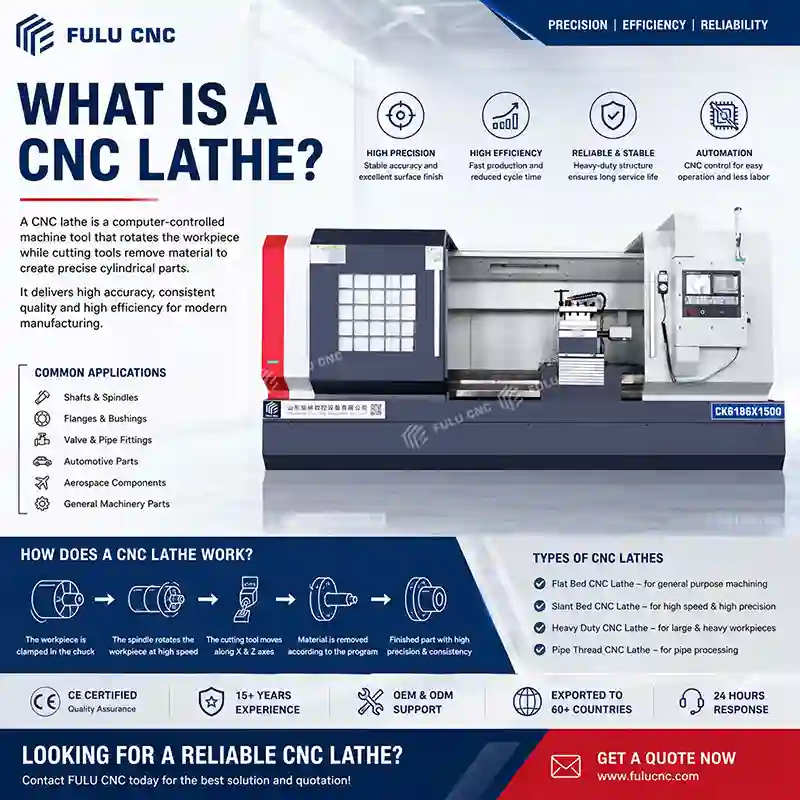
A CNC lathe is controlled by computer programs. Operators write machining programs using G-code which the CNC system uses to control the movement of the machine's axes and cutting tools.
The typical machining process is as follows:
Since all actions are precisely controlled by the CNC system, product quality consistency can be ensured even in mass production.
Understanding the core components of a CNC lathe helps in selecting equipment configurations better suited to your needs.
The bed is the foundation of the entire machine, providing high rigidity support to effectively reduce vibration and ensure machining stability.
The spindle box houses the spindle and drive motor, providing rotational power to the workpiece.
The chuck is used to firmly hold the workpiece. Hydraulic chucks, due to their greater clamping force and higher efficiency, are widely used in modern CNC lathes.
The turret can automatically change tools, allowing multiple machining processes to be completed continuously without manual tool changes, improving production efficiency.
The tailstock is used to support longer workpieces, enhancing machining rigidity and reducing deformation during processing.
The CNC system is equivalent to the brain of the machine tool, responsible for executing machining programs and coordinating the movement of each axis.
Common control system brands include:
Different machining requirements are suitable for different types of CNC lathes.
Flat bed CNC lathes are suitable for general turning operations, featuring good rigidity, easy maintenance, and high cost performance.
Typical machined parts include:
The slant bed CNC lathe adopts a slant bed structure, offering better chip removal performance, higher overall rigidity, and greater machining accuracy.
Widely used in:
The heavy-duty CNC lathe is specially designed for machining large, long-sized workpieces and those with high cutting loads.
Suitable for:
The CNC threading lathe is specifically designed for processing various pipe threads required in the petroleum, natural gas, and pipeline industries.
The CNC lathe offers extremely high dimensional accuracy and repeat positioning precision, making it ideal for high-precision machining.
Automated machining can significantly shorten processing cycles and improve production efficiency.
Stable cutting conditions achieve better surface finish and reduce subsequent manual rework.
One operator can manage multiple machines simultaneously, greatly reducing labor input.
Different products can be machined by simply modifying the program without changing the machine tool structure.
Computer control eliminates manual operation errors, making batch product quality more stable.
CNC lathes can perform various machining processes, including:
Many high-end CNC turning centers also support powered turrets and C-axis machining, enabling compound machining such as milling.
CNC lathes are widely used in various industries.
Machining drive shafts, brake components, wheel hubs, and engine parts.
Manufacturing high-precision aerospace components to meet stringent tolerance requirements.
Machining pipe threads, valves, fittings, and drilling equipment parts.
Manufacturing surgical instruments and various precision medical components.
Processing gears, rollers, sleeves, flanges, and various mechanical components.
Before purchasing a CNC lathe, focus on the following factors:
Confirm the maximum swing diameter, maximum machining length, and spindle bore size required for the product.
Select the appropriate machine tool grade based on product accuracy requirements.
For large-scale production, it is recommended to choose a slant bed CNC lathe equipped with a servo turret or automatic loading and unloading system.
Select a reliable control system based on production needs, such as:
The following configurations can be added as needed:
FULUCNC is a professional Chinese CNC machine tool manufacturer with extensive experience in precision machine tool manufacturing.
We offer:
Our products have been exported to more than 60 countries and regions worldwide, trusted by manufacturing enterprises around the globe.
CNC stands forComputer Numerical Control, which means the machine tool is automatically controlled by computer programs instead of manual operation.
CNC lathes can process:
A CNC lathe automatically controls the machining process through computer programs, while a conventional lathe requires the operator to manually control each machining operation.
CNC lathes are widely used in industries such as automotive, aerospace, medical, energy, mold manufacturing, industrial equipment, and general metal processing.
Modern CNC lathes typically achieve±0.005 mm to ±0.01 mm positioning accuracy, depending on the machine model and configuration.
CNC lathes are essential machines in modern manufacturing, featuringhigh precision, high efficiency, high stability, and flexible machining capabilities.Whether you produce automotive parts, aerospace products, pipe fittings, or general mechanical components, choosing the right CNC lathe can significantly improve production efficiency and product quality.
If you are looking fora reliable CNC lathe manufactureror wish to obtain professional equipment selection advice,FULUCNC can provide you with a wide range of CNC turning solutions to meet different production needs.
👉 Contact FULUCNC now for a free quote and professional machine tool selection plan!