As manufacturing continues to advance towards automation and intelligence, CNC machining centers have become essential equipment in modern machining. Among them,the Automatic Tool Changer (ATC)is one of the key technologies for improving machining efficiency and achieving continuous production.
The automatic tool changer can automatically switch between different cutting tools according to the machining program without manual intervention, greatly reducing tool change time and improving machining accuracy and production efficiency. Today, ATCs are widely used in vertical machining centers (VMC), horizontal machining centers (HMC), high-speed machining centers, as well as four-axis and five-axis CNC machines.
So,how exactly does the automatic tool changer work?This article will provide a detailed introduction to the working principle, main components, common types, advantages, application fields, and how to choose the right automatic tool changing system for your needs.
How does the automatic tool change device work? How does the automatic tool changer (ATC) work? Understand the principle of automatic tool change in machining centers in one minute. Why does the machining center change tools so quickly? Unveiling the automatic tool change device! Automatic Tool Change Device Automatic Tool Change Device is an automation device installed on CNC machining centers, used to automatically complete the selection, exchange, and installation of tools according to the processing program, without the need for manual intervention.
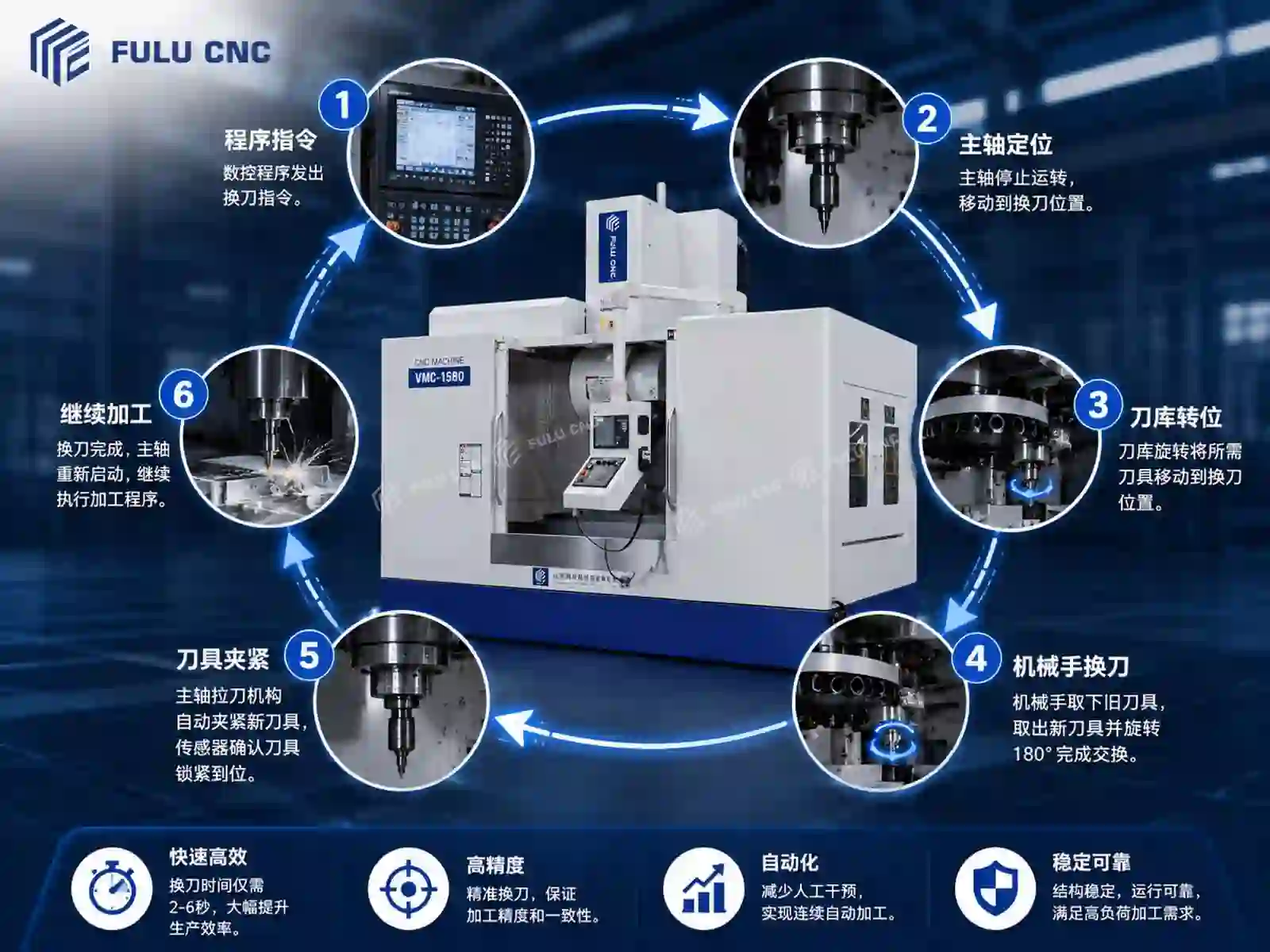
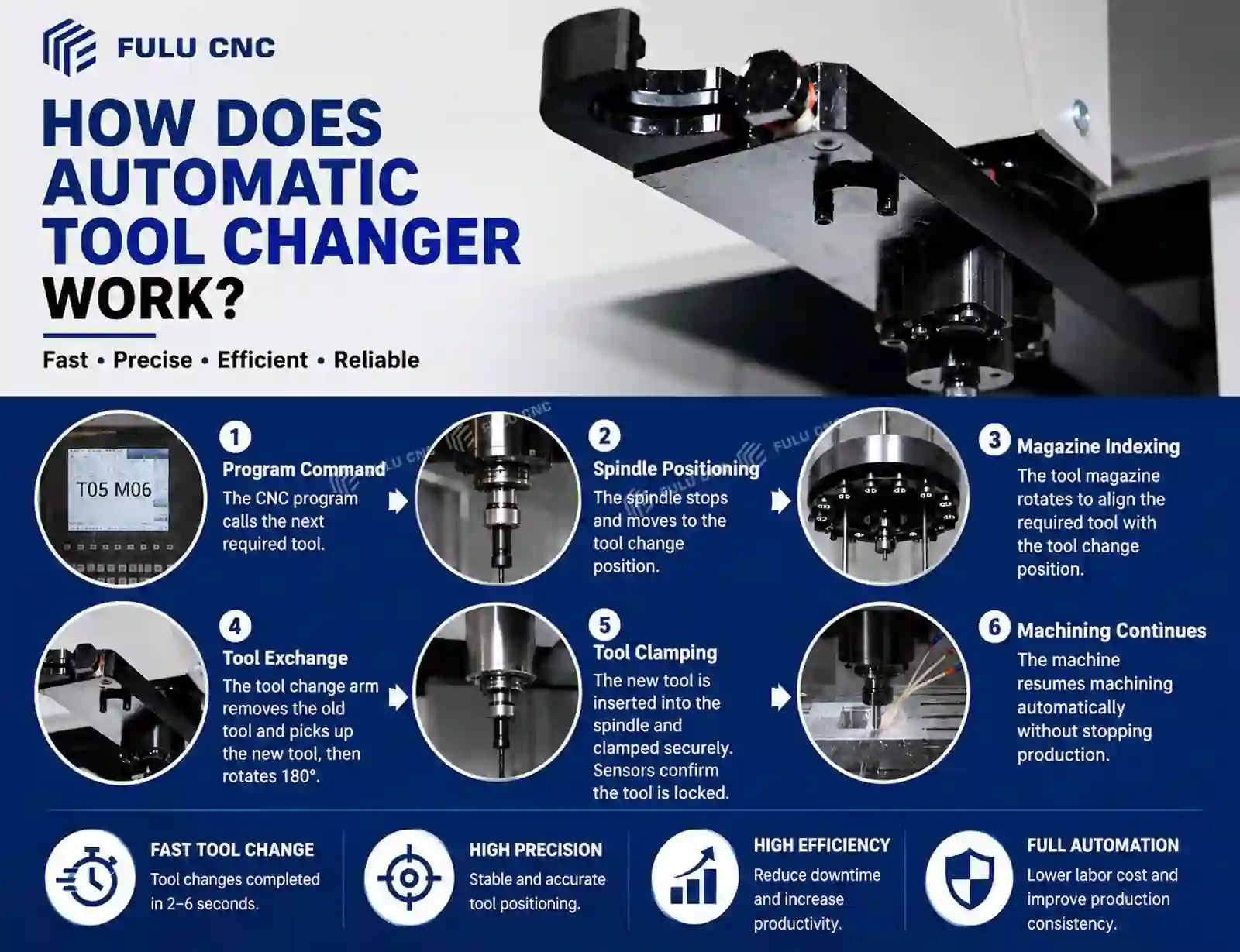
The Automatic Tool Changer (ATC) is an automated tool changing system installed on CNC machining centers that can automatically store, select, exchange, and install tools according to the CNC program.
In traditional machining processes, operators need to stop the machine to change tools after completing each operation, which not only wastes time but also can affect machining accuracy. CNC machining centers equipped with ATCs can automatically complete the entire tool changing process, allowing multiple machining operations such as milling, drilling, tapping, and boring to be performed continuously, thereby significantly improving production efficiency.
The automatic tool changer can usually change the following tools:
Modern machining centers can automatically complete dozens or even hundreds of tool changes in a single machining cycle.
The automatic tool changer is controlled uniformly by the CNC system and follows the M06 tool change command in the machining programAutomatically execute the entire tool change process.
A complete ATC workflow typically includes the following steps:
When the program reaches the tool change command, the CNC system automatically selects the next required tool according to the program.
For example:
Indicates the machine automatically callsTool No. 5.
Upon receiving the tool change command, the spindle stops rotating and automatically moves to the preset tool change position, preparing for the next step of the tool change.
The tool magazine rotates according to the instructions from the CNC system, moving the required tool to the position where the robotic arm can grasp it.
Depending on the configuration of the machining center, the tool magazine capacity is usually:
The automatic tool-changing robot performs two actions simultaneously:
Then the robot rotates 180°, installs the new tool onto the spindle, and returns the old tool to the tool magazine.
The entire process usually takes only 2 to 6 seconds to complete.
After the new tool is installed, the spindle automatically clamps the tool holder through the pull-in mechanism.
The internal detection sensors of the machine tool confirm that the tool is correctly installed and securely locked, ensuring safe and reliable subsequent machining.
After the tool change is completed, the spindle restarts, and the CNC system continues to execute the subsequent machining program, achieving continuous automatic operation of the entire machining process without manual intervention.
A complete ATC system usually consists of the following parts:
The tool magazine is used to store various tools required during the machining process.
Common capacities include:
The larger the tool magazine capacity, the more complex machining processes can be completed.
The robot is responsible for quickly exchanging tools between the spindle and the tool magazine, serving as the core actuator of the entire automatic tool changing system.
The spindle is responsible for installing tools and performing cutting operations, automatically releasing and clamping tools during the tool change process.
The pull stud mechanism is used to securely lock the tool holder in the spindle taper hole, ensuring stability and precision during the machining process.
Common tool holder specifications include:
Different specifications are suitable for different types of machining centers and machining requirements.
The CNC system is responsible for controlling all actions of the ATC, including tool selection, tool magazine rotation, robotic arm tool changing, and spindle clamping.
Common brands include:
According to different structures, automatic tool changers are mainly divided into the following three types:
Uses a disc-type tool magazine, compact structure, lower cost, easy maintenance, suitable for small vertical machining centers.
Uses a dual mechanical arm structure, fast tool changing speed, large tool capacity, suitable for mid-to-high-end machining centers and mass production.
Uses chain circulation to store tools, capable of holding more than 40 to 100 tools, suitable for aerospace, large molds, and complex parts machining.
The automatic tool changer offers numerous advantages for manufacturing enterprises, including:
Automatic tool changers are widely used in the following industries:
When selecting a CNC machining center equipped with an ATC, the following factors should be focused on:
Choosing the appropriate automatic tool changer system based on product complexity, production volume, and budget can effectively improve machining efficiency and equipment utilization.
The automatic tool changer (ATC) is an important component of modern CNC machining centers to achieve high efficiency, high precision, and automated production. By automatically selecting, changing, and installing tools, the ATC effectively reduces downtime, improves machining efficiency, and meets the needs of continuous multi-process machining of complex parts.
With the continuous development of intelligent manufacturing and automated production, automatic tool changing technology will play an increasingly important role in the CNC machining field. For enterprises that need to improve production efficiency and ensure machining quality, choosing CNC machining centers equipped with high-performance ATC systems is an important step to enhance manufacturing competitiveness.