
CNC Lathe vs Manual Lathe | Key Differences and Buying Guide | FULUCNC
Compare CNC lathes and manual lathes in terms of machining accuracy, production efficiency, cost, and application scenarios to help you choose the equipment that best meets your company's production needs. Contact FULUCNC for professional selection advice.
Lathes are among the most widely used machine tools in manufacturing. Whether machining automotive parts, shafts, flanges, molds, or precision mechanical components, choosing the right lathe directly affects production efficiency, machining accuracy, and manufacturing costs.
The two most common types of equipment currently areCNC LatheandManual LatheAlthough both are used for turning operations, there are significant differences in automation level, machining accuracy, production efficiency, and applicable fields.
This article will provide a comprehensive comparison ofCNC lathes and manual lathesto help you choose the machining equipment that best suits your production needs.
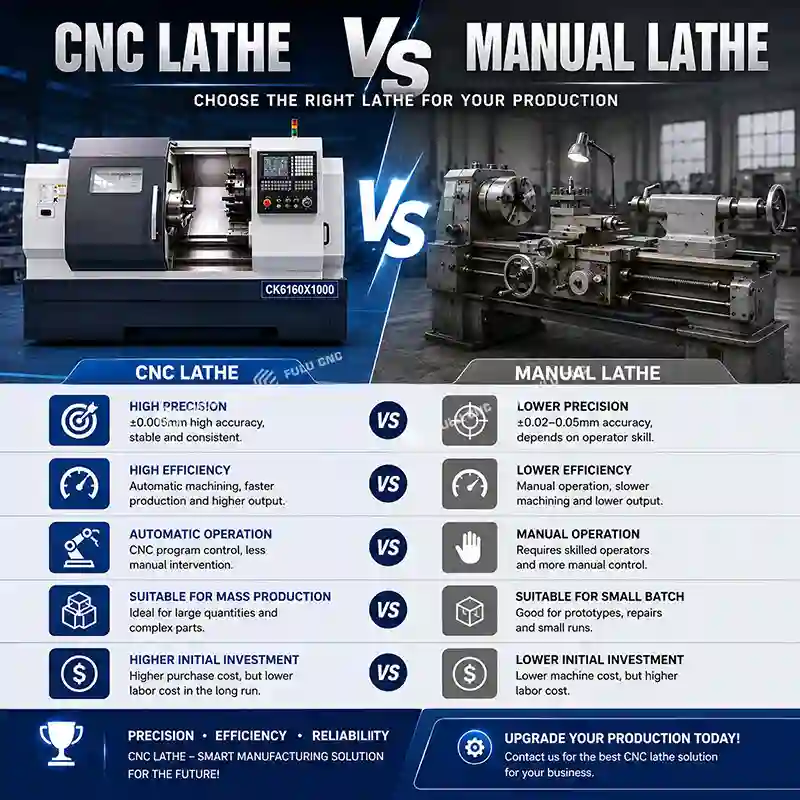
A CNC lathe is an automated machine tool controlled by computer programs. Operators only need to input the machining program, and the equipment can automatically complete turning, facing, drilling, boring, tapping, threading, grooving, and other machining processes while maintaining extremely high machining accuracy.
Modern CNC lathes typically have the following features:
CNC turning centers are widely used in:
A manual lathe relies entirely on the operator to complete machining through handwheels and mechanical control devices.
All machining actions, including feed rate, cutting depth, and tool movement, need to be manually controlled.
Manual lathes are typically used for:
Although manual lathes offer some flexibility in single-piece processing, they require a high level of operator experience and their production efficiency cannot compare to CNC lathes.
| Comparison Items | CNC Lathe | Manual Lathe |
|---|---|---|
| Operation mode | Computer program control | Manual operation |
| Processing accuracy | High (±0.005mm or higher) | Depends on operator experience |
| Repeatability | Very high | General |
| Processing speed | High | Relatively low |
| Complex parts machining | Easily accomplished | Higher difficulty |
| Labor requirements | One person can manage multiple devices | One person operates one device |
| Degree of automation | Fully automatic | Manual operation |
| Production efficiency | Suitable for mass production | Suitable for small batch production |
| Initial Investment | Higher | Lower |
| Long-term Cost | Lower Unit Cost | Higher Labor Cost |
CNC lathes have extremely high machining accuracy and repeat positioning accuracy, making them ideal for industries with strict dimensional tolerance requirements.
Once the program is completed, the CNC lathe can continuously and automatically machine the same parts with minimal manual intervention, greatly improving production efficiency.
A single operator can manage multiple CNC lathes simultaneously, significantly reducing labor input.
Stable spindle speed and precise feed control can achieve better surface finish while reducing secondary processes such as polishing.
CNC lathes can easily machine:
Manual lathes still have the following advantages:
For workshops that only occasionally machine small quantities of parts, manual lathes remain an economical and practical investment.
Today, CNC lathes have become standard equipment in the following industries:
If you meet the following conditions, it is recommended to choose a manual lathe:
If you have the following needs, a CNC lathe will be a better choice:
As a professionalChinese CNC lathe manufacturerFULUCNC is committed to providing reliable, high-performance CNC machining solutions to customers worldwide.
Whether you need compact precision machining equipment or heavy-duty CNC lathes suitable for large workpieces, FULUCNC can provide you with the right solution.
Choosing CNC LatheorManual Lathemainly depends on your production goals.
If you prioritizeprocessing accuracy, production efficiency, repeat consistency, and large-scale manufacturing capability,then CNC lathes are undoubtedly the best choice.
For maintenance machining, teaching and training, or occasional single-piece processing, manual lathes remain an economical and practical solution.
As manufacturing continues to advance towards intelligence and automation, CNC lathes have become the preferred equipment for more and more companies to improve production efficiency and market competitiveness.
Yes. Since all movements are controlled by computer programs, CNC lathes offer higher machining accuracy and repeat positioning precision.
Absolutely. Manual lathes are still widely used in maintenance machining, teaching and training, prototype trial production, and small batch manufacturing.
CNC lathes are designed for large-scale production, featuring faster machining cycles and stable, consistent product quality.
For companies engaged in long-term parts processing, CNC lathes usually have a high return on investment. They can improve production efficiency, reduce labor costs, and ensure product quality consistency.